Monitor Subscriptions and Compatibility
After subscribing to a shared domain, consumer applications can monitor subscription health, compatibility status, dispatch mode, and access state through the My Subscriptions workflow in Studio. Compatibility validation helps identify package-version or schema mismatches between provider and consumer applications, while subscription monitoring provides visibility into the current communication and access state for each subscribed domain.
Monitoring Subscriptions and Compatibility
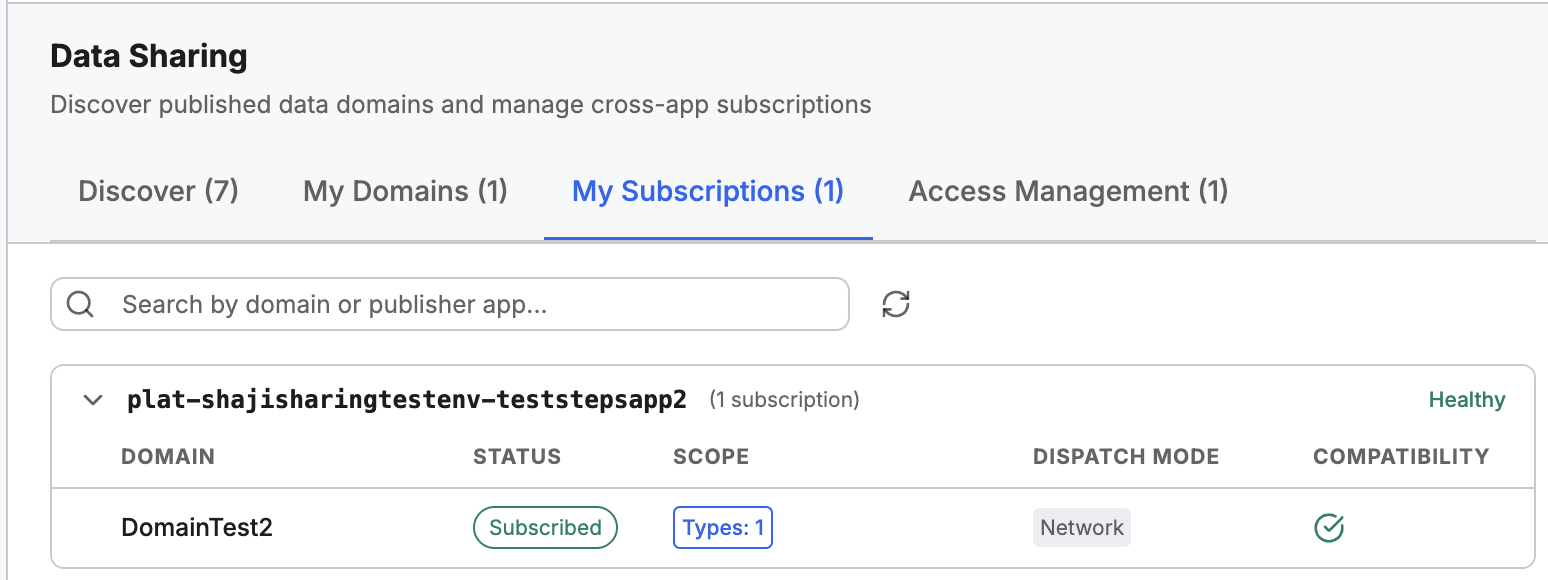
The My Subscriptions tab displays the domains the consumer application has subscribed to.
Subscriptions are grouped by provider application. Each entry includes:
- Domain — the subscribed domain name
- Status — the current subscription state for the consumer application (for example, Subscribed)
- Scope — the packages or types exposed by the domain
- Dispatch Mode — the communication mode used to access the provider domain
- Compatibility — controls for validating compatibility between the consumer application and the provider domain
- Actions — controls for unsubscribing from the domain
The Dispatch Mode identifies how requests are routed to the provider domain. Depending on the subscription configuration, the current implementation displays either Network or Local JVM.
The Compatibility column includes a Check action for validating compatibility between the consumer application and the provider domain.
To unsubscribe from a domain:
- Open the My Subscriptions tab.
- Locate the subscription.
- Click the Unsubscribe icon in the Actions column.
- Confirm the unsubscribe action.
Removing a subscription disconnects the consumer application from the provider domain.
Package Compatibility Check
Cross Application Data Sharing includes package compatibility validation between the consumer application and the provider domain.
The compatibility check helps identify package-version or schema mismatches that could affect interoperability between applications.
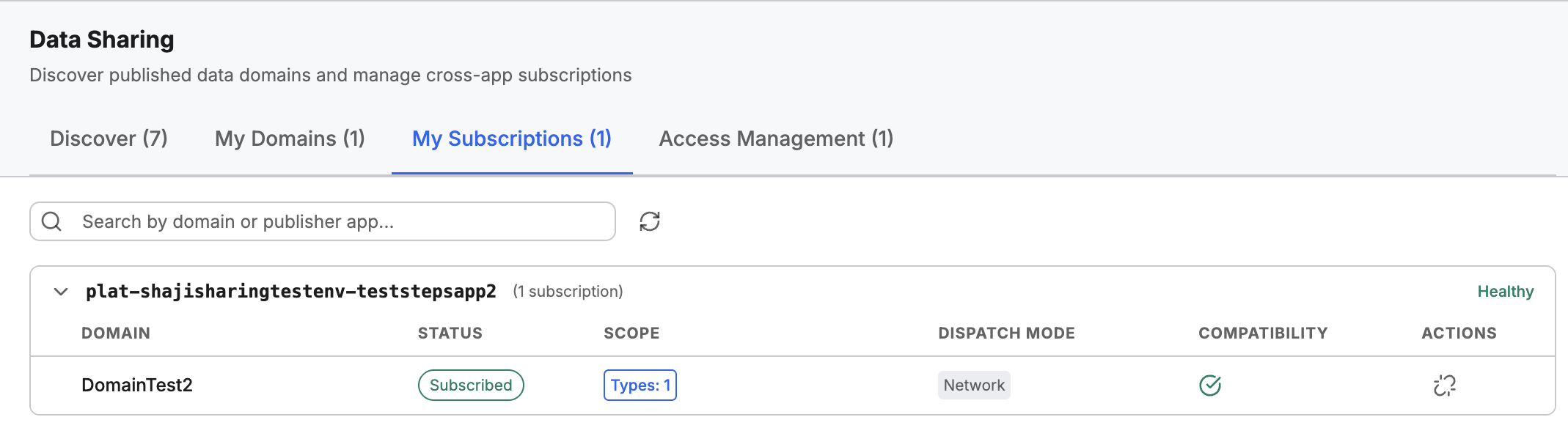
The current implementation validates compatibility between the consumer and provider applications and surfaces the results in the Compatibility column of the My Subscriptions tab.
Compatibility validation can be triggered from the Compatibility column in the My Subscriptions tab. The validation results are advisory and do not block subscription creation.
Known limitation: Cross Application Data Sharing compatibility validation applies to entity types only and does not support custom interface types.
Understanding Subscriptions and Access Approval
Subscribing to a domain and being granted access to a domain are separate operations in Cross Application Data Sharing.
A subscription establishes the connection between the consumer application and the provider domain. Once subscribed, requests for shared entity types are routed to the provider application's shared domain instead of the consumer application's internal datastore.
Access approval determines what level of access the consumer application has to the shared domain. A provider application can grant either:
- READ access
- READ & WRITE access
Access is managed through the provider application's approval workflow.
Because subscriptions and access approval are independent, a domain can appear in different states:
- Subscribed — the consumer application has successfully subscribed to the provider domain.
- Access Pending — the consumer application has requested access, but the provider application has not yet approved the request.
- Subscribed + Access Pending — the consumer application is subscribed to the domain, but the access request is still pending approval. In this state, requests are routed to the provider application, but access-controlled operations may not succeed until access is approved.
- Subscribed + Access Denied — the consumer application is subscribed to the domain, but the provider application has denied the associated access request. In this state, subscription metadata remains visible, but access-controlled operations are not permitted.
In the current implementation, applications can technically subscribe to their own domains. However, self-subscription does not change how the application accesses its own data because the application is already querying its own data.