End to End ML Model Lifecycle Management
This topic explains an end to end flow for machine learning model lifecycle management using C3 data science tools.
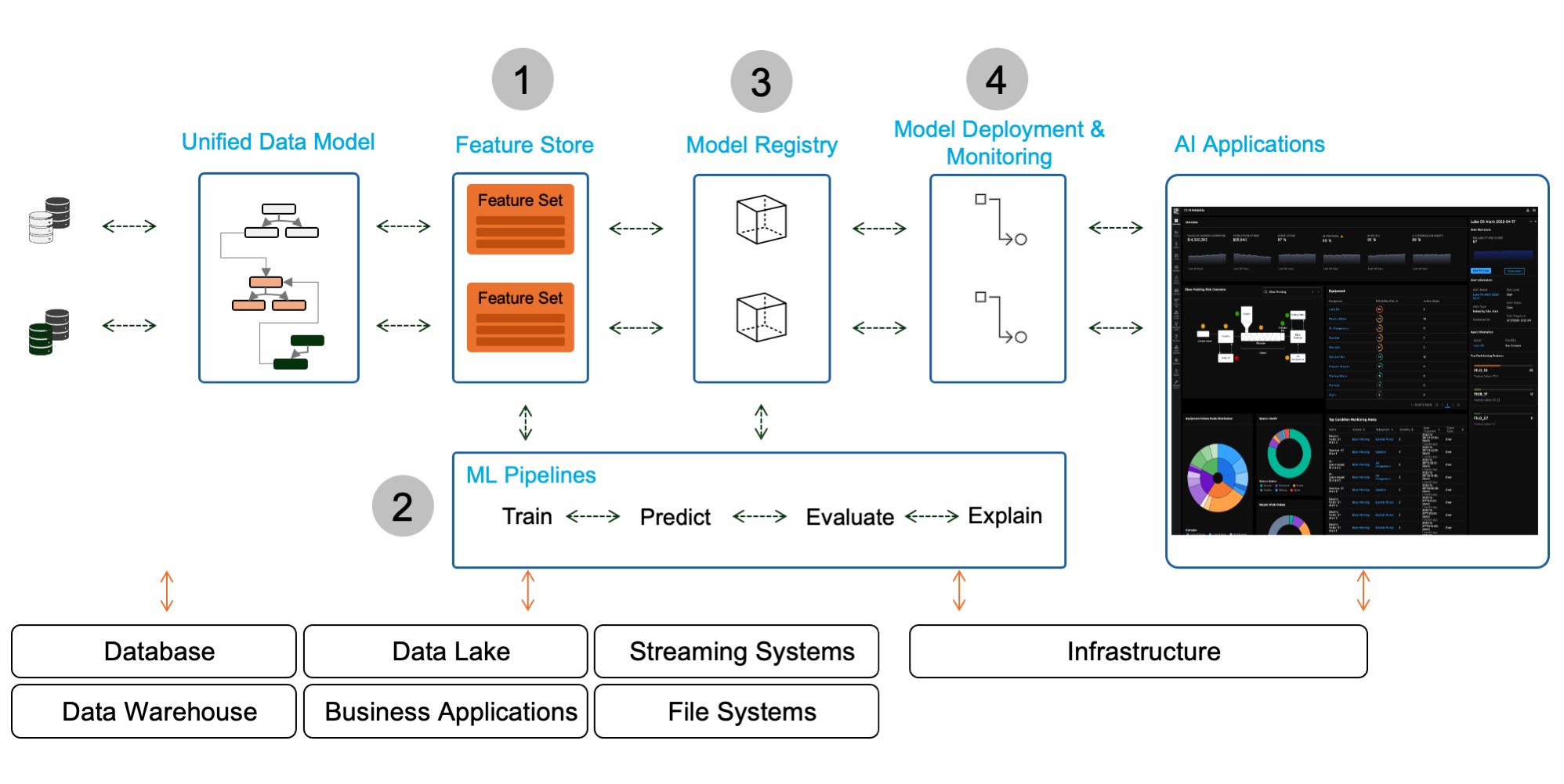
Prepare data
To begin your ML model lifecycle, you need to prepare data for use.
Use data management tools at C3 to make sure your model gets the right kind of data. You can create, update, and remove data, or you can fetch and filter data from a database.
Use ML Dynamic pipes for prototyping and testing your data.
Build
Depending on how your data is stored, you may have to build a data model to access your data. All data pipelines developed with the C3 Agentic AI Platform leverage a canonical data model, allowing for communication and translation between different data formats.
ML model
To start working on ML models within C3, it may be helpful to understand the Model Deployment Framework (MDF). You can learn more from the Model Deployment Tutorial.
For information on custom ML Pipe development, see the MlDynamicPipe Tutorial.
Feature store
C3 AI provides a feature store to store data inputs for a machine learning model. You can learn more about C3 AI Feature Store in the C3 AI Feature Store Overview topic.
Versioning and model management
Learn more about versioning in the Update and Version Models topic.
Testing and validation
You can validate your notebook tests on C3. For more information, see the Run Notebook Tests topic.
Train
While training your models, you can consider resource management to save on costs. See the Configure and Manage Node Pools or Use Adaptive Autoscaling to Configure the Scaling of Compute topics for more information on potentially using resources efficiently on your cluster.
For an example of training at scale, see Hyperparameter Optimization at Scale - HPO Tutorial
Deploy
For more information on deployment, see the Model Deployment Overview topic.
For an example, see Tutorial Model Deployment - Predictive Maintenance for Wind Turbines.